
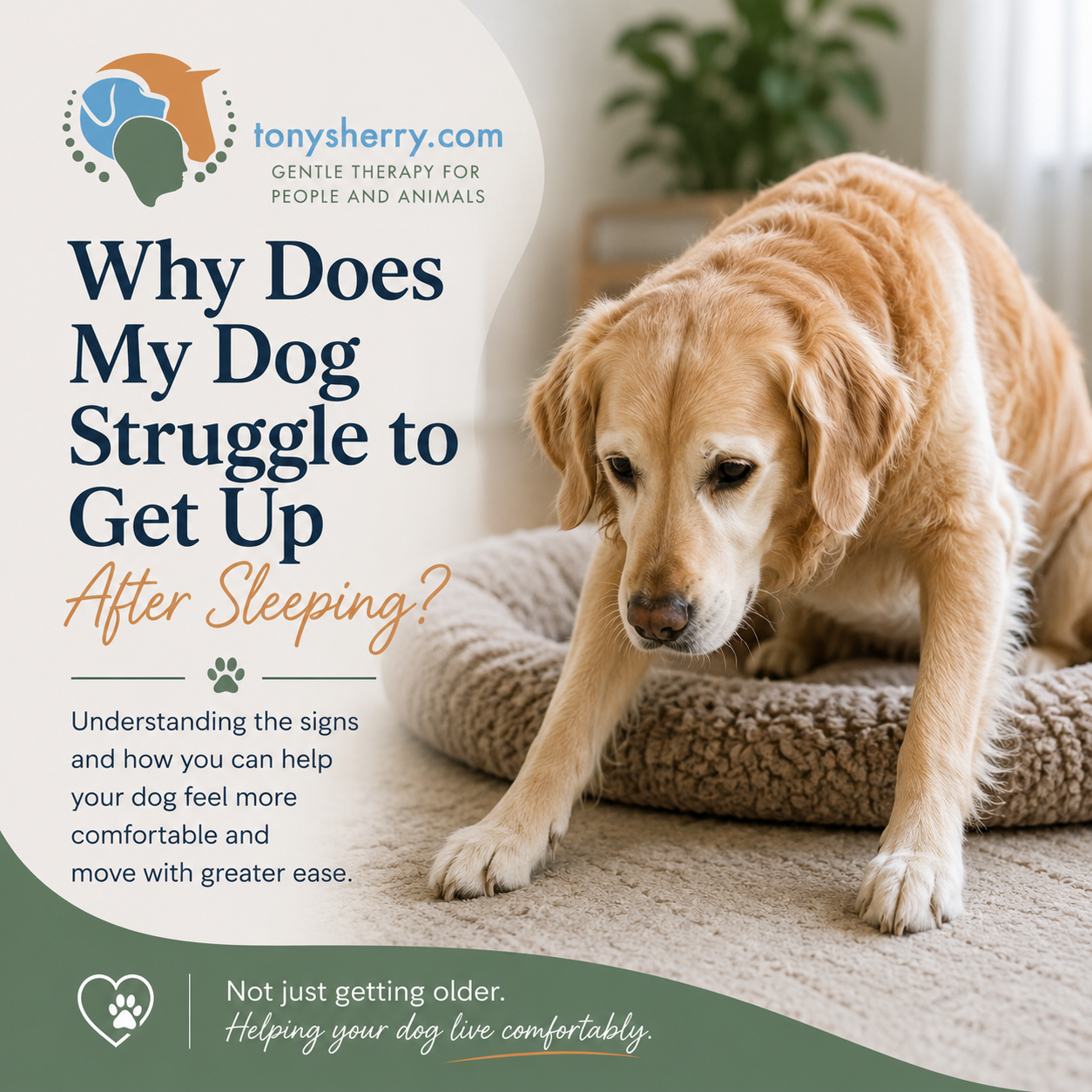
You call your dog for their morning walk. They lift their head enthusiastically, but when they try to stand, something looks different.
Perhaps their back legs take a few seconds to cooperate. They push themselves up with their front legs first, hesitate, stretch, or take several stiff steps before beginning to move more normally.
Later in the day, they may appear almost completely fine.
It can be tempting to put this down to age. You might even find yourself saying, “They’re just getting old.”
But difficulty getting up after sleeping is something worth paying attention to.
It doesn’t necessarily mean that something serious is wrong, and many dogs become a little slower as they age. However, changes in the way your dog gets up, walks or moves can sometimes be an early indication of pain, stiffness, weakness or another underlying problem.
The important thing is to notice the change rather than simply accepting it.
Why can dogs be stiff after sleeping?
When a dog has been asleep or resting for some time, their body has been relatively still.
Just as we can feel stiff when getting out of bed or standing after sitting for a long time, dogs can experience stiffness when they first begin moving.
This may be particularly noticeable in older dogs or dogs with joint or musculoskeletal problems.
You might notice that your dog:
- takes several attempts to stand
- pushes themselves up mainly using their front legs
- struggles to get their back legs underneath them
- stretches immediately after standing
- walks stiffly for the first few steps
- briefly limps after resting
- hesitates before getting out of their bed
- slips on smooth floors
- seems reluctant to use stairs
- no longer jumps onto furniture or into the car as easily
- appears much better after walking around for a few minutes.
That last point can sometimes cause owners to dismiss what they have seen.
“Once he’s moving, he’s fine.”
But the fact that a dog improves after moving doesn’t necessarily mean the initial difficulty should be ignored.
Is my dog simply getting old?
Ageing certainly changes a dog’s body.
Muscle mass and strength can decrease, joints may become less flexible, and older dogs can develop conditions that affect mobility.
But age itself isn’t a diagnosis.
If your dog is becoming noticeably slower or finding movements difficult that were previously easy, it’s worth asking whyrather than assuming that nothing can be done because of their age.
A useful question is:
“Is my dog getting older, or is getting older revealing something that is making movement more difficult?”
There is an important difference.
Older dogs still deserve to be as comfortable, mobile and engaged with life as possible.
What could cause difficulty getting up?
There isn’t one single explanation.
Difficulty rising after rest can be associated with many different issues, which is why veterinary assessment is important if the problem is new, persistent, worsening or significant.
Possible causes can include joint problems such as osteoarthritis, muscular discomfort, reduced muscle strength, previous injuries, hip or knee problems, spinal conditions and neurological problems.
Other medical conditions can also affect strength and mobility.
This is why it isn’t sensible to diagnose the cause simply by watching how a dog stands up.
What you can do is notice that something has changed.
That observation can be extremely useful.
Look at the whole dog, not just their legs
When owners notice their dog struggling to stand, they naturally look at the legs.
But mobility involves the whole body.
Your dog has to shift their weight, position their feet, stabilise their body and coordinate numerous muscles and joints simply to move from lying down to standing.
Sometimes the most useful thing you can do is watch the entire movement.
Does your dog roll onto their chest first?
Do they pull themselves forwards with their front legs?
Do the back legs hesitate?
Does one leg seem to take more weight than another?
Do they stand with their back rounded?
Do they stretch repeatedly?
Do they shake themselves immediately afterwards?
Does their tail position look different?
Does their movement improve after ten or twenty steps?
These small details can provide useful information for your vet and other professionals involved in your dog’s care.
Dogs don’t always show pain in obvious ways
One of the challenges for dog owners is that discomfort isn’t always accompanied by crying, yelping or obvious limping.
Dogs can continue eating, greeting us enthusiastically and asking for walks while experiencing discomfort.
Sometimes the signs are much more subtle.
You may notice your dog becoming less enthusiastic about a long walk.
They may stop jumping onto the sofa.
They may stand at the bottom of the stairs and think about it before going up.
They may wait for you to lift them into the car.
Perhaps they change position repeatedly when trying to sleep.
Some dogs become quieter, while others can become irritable or less tolerant of being touched.
None of these signs proves that a dog is in pain, but changes in behaviour and movement deserve attention.
You know what is normal for your dog.
That makes you one of the most important observers of subtle change.
Watch what happens after exercise too
Getting up after sleeping isn’t the only useful time to observe your dog.
Notice how they move after a walk.
Some dogs appear comfortable while exercising but become noticeably stiff after returning home and resting.
You might notice that your dog sleeps for an hour after their walk and then struggles when they get up again.
That information can be valuable.
Consider whether the stiffness seems worse after:
- longer walks
- running
- playing with other dogs
- climbing hills
- using stairs
- jumping
- getting in and out of the car
- unusually active days.
Patterns can sometimes tell us far more than one isolated episode.
Try keeping a simple mobility diary
If you’re uncertain whether your dog’s mobility is changing, keep a short record for a week or two.
It doesn’t need to be complicated.
Make a note of how easily they get up in the morning, how they move after walks, whether they use stairs normally, whether they’re still jumping into the car and whether you’ve noticed any change in their enthusiasm for exercise.
One particularly useful tool is your phone.
If your dog is struggling to stand, take a short video if you can do so without delaying urgent care.
Dogs don’t always demonstrate the same problem when they arrive at the veterinary surgery. A video showing exactly what you’ve noticed at home can therefore be extremely helpful.
You can also take occasional videos of your dog walking from the side, front and behind so that changes over time are easier to recognise.
When should I speak to my vet?
A new or unexplained change in mobility should be discussed with your vet, particularly if it persists, becomes worse or appears painful.
Seek veterinary advice promptly if your dog suddenly cannot stand, collapses, cries out in pain, drags a limb, develops marked weakness, seems distressed or shows a sudden significant deterioration.
Don’t attempt to manipulate, stretch or treat a dog yourself when you don’t know what is causing the problem.
Your vet can assess whether there is an underlying medical, orthopaedic or neurological cause and advise you about appropriate treatment.
Depending on the problem, this might include medication, weight management, changes to exercise, physiotherapy or rehabilitation, environmental changes or other forms of support.
Small changes at home can make a big difference
There are also practical things that can make life easier for a dog whose mobility is changing.
One of the simplest is to look at your floors.
Laminate, tiles and polished wooden flooring can become difficult for dogs who don’t have the strength or stability they once had. They may be able to stand comfortably on carpet but struggle when their feet slide away from them on a smooth surface.
Non-slip runners or mats around their bed and along frequently used routes can help provide secure footing.
Also consider:
- whether their bed is supportive and easy to get in and out of
- reducing unnecessary jumping
- using a ramp where appropriate
- keeping nails at a suitable length
- maintaining a healthy body weight
- providing regular, appropriate exercise rather than occasional excessive activity.
Your vet or rehabilitation professional can advise you about changes appropriate for your individual dog.
Where can complementary therapy fit?
Once veterinary problems requiring specific treatment have been assessed, complementary therapy may be one part of a wider approach to supporting comfort and mobility.
My own work with dogs uses gentle, light-touch techniques.
I don’t believe that helping a dog should mean forcing their body into uncomfortable positions or applying increasingly firm pressure.
I also believe strongly in consent.
When I work with a dog, I want them to feel safe. I allow them time to approach me and become comfortable with my presence. Their body language helps guide the session.
Some dogs choose to stand. Others sit or lie down. Some move away and return when they’re ready.
I respect that.
The objective isn’t to make a dog tolerate treatment.
It is to work with them.
Depending on the individual dog and their veterinary situation, I may use gentle complementary techniques and, where appropriate, red light therapy as part of supporting their comfort and movement.
These approaches do not replace veterinary diagnosis or treatment.
They can, however, form part of a broader plan focused on helping your dog remain comfortable and active.
Don’t wait for a limp before noticing change
Perhaps the most important message is this:
Your dog doesn’t have to be limping before their movement deserves attention.
Difficulty getting up after sleeping may be one of the first changes you notice.
Maybe it’s taking them five seconds longer than it used to.
Perhaps they hesitate before standing.
Maybe the first few steps look stiff.
Individually, these things can seem insignificant.
But you see your dog every day.
You know how they normally move, behave, sleep, play and interact with you.
If something has changed, pay attention to it.
Early recognition gives you the opportunity to investigate what is happening and consider what support may be appropriate.
Is your dog telling you something?
Next time your dog wakes from a long sleep, take a moment to watch them get up.
Don’t just look for a limp.
Watch the whole movement.
How easily do they rise?
Where do they place their feet?
Do they hesitate?
Are those first few steps stiff?
Do they stretch repeatedly?
And, perhaps most importantly:
Is this different from how they moved six months ago?
Getting older is inevitable.
Living with unnecessary discomfort shouldn’t simply be accepted as part of it.
If you’ve noticed your dog becoming stiff, slowing down or struggling to get up after resting, your first step should be to speak to your vet about unexplained or persistent changes.
Once appropriate veterinary assessment has taken place, complementary therapy may be another option to consider as part of supporting your dog’s comfort, mobility and quality of life.
Could I help your dog?
I provide gentle, consent-led complementary therapy for dogs, including home visits across West Kent and East Sussex.
Working with dogs in their own environment can be particularly valuable because they are somewhere familiar, surrounded by the people, smells and routines they know.
If you’ve noticed changes in the way your dog moves and would like to discuss whether my approach could be suitable alongside their veterinary care, please get in touch.
Sometimes the first sign that something needs attention isn’t a limp. It’s simply noticing that getting up isn’t as easy as it used to be.